












































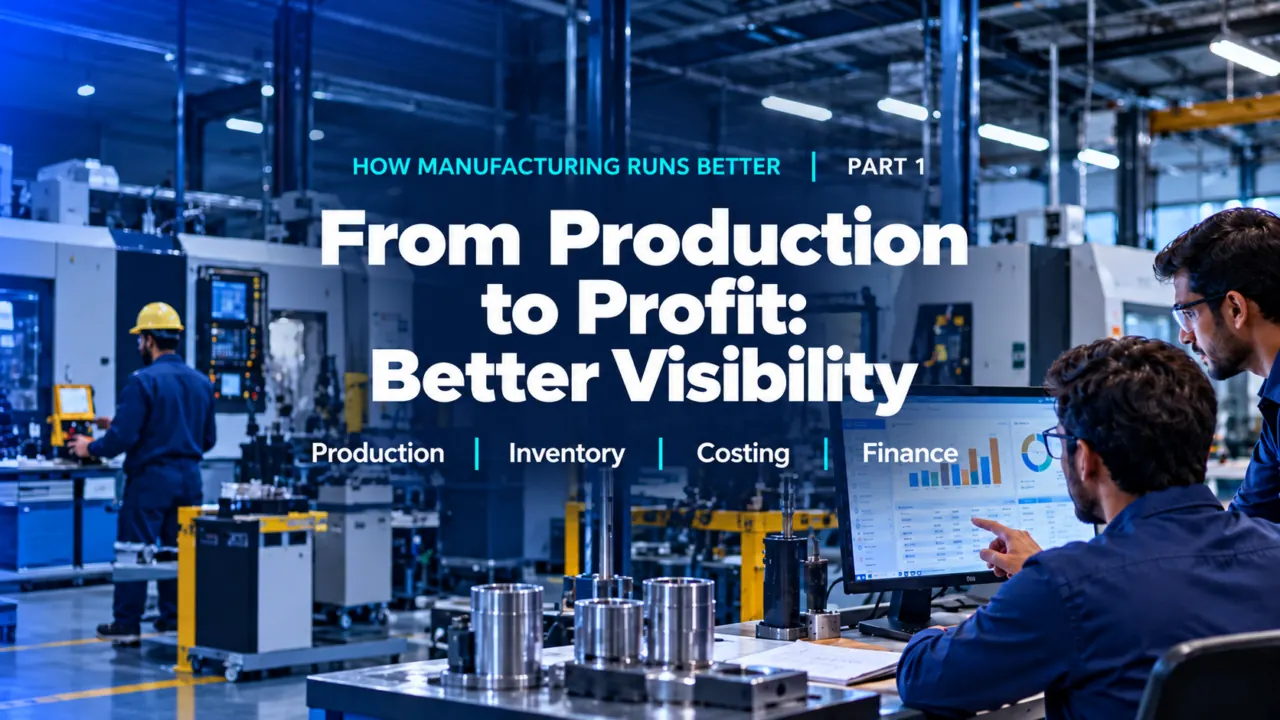
Manufacturing profitability rarely disappears in one dramatic event. More often, it leaks through small gaps: materials arriving late, planners working from old demand, work-in-progress sitting longer than expected, inventory not matching the shop floor, and finance seeing the real cost only after the month is over.
For growing manufacturers, the real challenge is not a lack of data. It is the lack of one connected view from production activity to financial impact. That is where SAP Business One for Manufacturing becomes relevant: it brings planning, purchasing, inventory, production, sales and finance onto a common operational foundation.
Where visibility gets lost
A production team may know what is scheduled today, while purchasing is still waiting for an updated material requirement. Sales may promise a delivery date without a current view of capacity. Finance may calculate profitability only after costs have been reconciled manually. Each team is doing its job, but the business is still operating with partial information.
A connected manufacturing ERP helps link production orders to material availability, inventory movements, purchasing and financial postings. Instead of asking different teams for different versions of the same number, managers can work from a shared system and investigate exceptions earlier.
What better visibility should look like
For manufacturers, useful visibility should answer practical questions quickly:
- Do we have the materials and capacity to complete planned production?
- Where is inventory sitting – raw material, work-in-progress or finished goods?
- Which orders or bottlenecks could affect promised delivery dates?
- How are production activity, inventory movement and cost affecting margin?
From production data to profit decisions
Better visibility does not mean adding more dashboards. It means reducing the blind spots between departments. For companies with component-based production, an ERP for discrete manufacturing can connect BOMs, resources, scheduling, inventory and supply-chain activity. For formula- or batch-driven businesses, an ERP for process manufacturing can add the traceability and production control needed around recipes, batches and quality.
The result is a clearer line from what is happening on the shop floor to what it means for delivery performance, working capital and profitability.
Ready to connect production to profit? Explore SAP Business One and Accelon’s manufacturing industry solutions for discrete manufacturing and process manufacturing to see how a connected ERP can improve visibility across your operation.