














































Retail planning is only as good as the data behind it. When retailers plan purchases, set sales targets, and allocate budgets, they need accurate, current information.
Most retail businesses do not have this. They plan based on experience, gut feel, and last season’s rough numbers. This leads to predictable problems. Some products sell out too fast. Others sit unsold for months.
Sales targeting and forecasting solve this. They replace guesswork with structured, data-driven planning. Every purchase decision, every sales target, and every promotional plan is anchored to real demand data.
At Accelon Technologies, we built B1Bazaar for exactly this purpose. It gives retailers on SAP Business One the sales targeting and forecasting tools they need to plan with confidence. This blog explains how these tools work and why they matter in the ERP for the retail industry.
Why Retail Planning Fails Without Structured Forecasting
Planning errors in retail are not always obvious when they happen. They show up later, in the form of excess stock, lost sales, or missed margin targets.
Understanding why these errors occur is the first step toward preventing them.
Sales Targets Are Set Without Historical Context
Many retail managers set monthly or quarterly targets based on what they remember from the previous year. Memory is unreliable. It does not account for seasonality shifts, product mix changes, or category-level trends.
Targets that are too high create pressure and unrealistic expectations. Targets that are too low leave revenue on the table. Neither serves the business well.
Purchase Planning Is Disconnected From Demand Signals
When buyers place orders without a clear view of how fast each product is selling, they make decisions based on supplier push rather than customer pull. The result is an inventory mix that does not match actual demand.
This is one of the most common profitability leaks in the ERP for the retail industry. Products that customers want run out. Products that do not sell accumulate in the stockroom.
Performance Tracking Happens Too Late
In many retail businesses, a manager reviews sales performance at the end of the month. By then, the month is over. Any course correction is too late to affect that period.
Weekly or daily performance tracking against targets allows managers to act while there is still time. This requires a system that makes the data available in real time.
Multi-Location Planning Lacks Consistency
Retailers with multiple stores often set targets store by store, without a consistent methodology. One store manager may be conservative. Another may be overoptimistic. The result is a plan that does not reflect actual market opportunity across the network.
A centralised planning tool ensures that targets and forecasts are built on the same data and the same logic across all locations.
What Sales Targeting and Forecasting Actually Do for Retailers
Sales targeting defines what each store, each category, and each team should achieve over a given period. It creates accountability and a benchmark for performance measurement.
Sales forecasting predicts what is likely to happen based on historical sales data, seasonality patterns, and current trends. It informs purchasing, staffing, and promotional planning.
Together, targeting and forecasting create a feedback loop. Targets are set based on forecasts. Actual results are measured against targets. Variance is analysed and fed back into the next forecast cycle.
This is how well-run retail businesses operate. B1Bazaar makes this process accessible within the SAP Business One platform.
How B1Bazaar Supports Sales Targeting and Forecasting
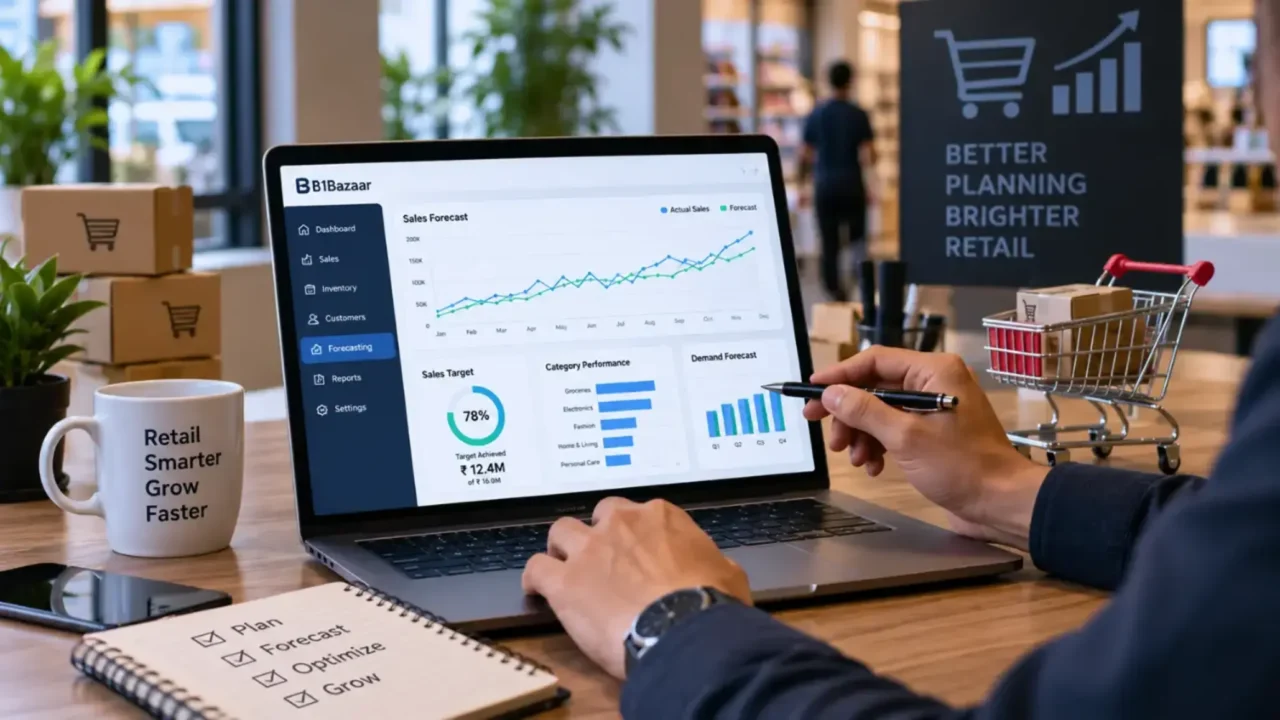
B1Bazaar is built natively on SAP Business One. Sales data from every transaction at every store feeds directly into the planning and reporting layer. There are no separate analytics tools and manual data export.
Target Setting at Store, Category, and Product Level
B1Bazaar allows management to define sales targets at multiple levels. A target can be set for the entire store, for a specific product category, or for an individual product.
These targets are active within the system during the target period. Every sale made contributes to the running total against the relevant target. Managers can check progress at any point without waiting for a report to be compiled.
Historical Sales Analysis as the Basis for Forecasting
B1Bazaar draws on the full transaction history stored in SAP Business One. Sales data can be analysed by day, week, month, quarter, or season. Patterns emerge from the data that are not visible when you are only looking at recent months.
A category that peaks every October, a product that consistently slows in January, a store that outperforms others during festival periods — these patterns are visible in the data. Forecasts built on this data are grounded in reality.
Seasonal and Trend-Based Demand Forecasting
Retail demand is rarely flat across the year. B1Bazaar accounts for seasonality when generating demand forecasts. Historical seasonal uplift and decline factors are applied to baseline demand figures.
This means that a forecast for a fashion retailer in October looks different from one in February. The system recognises the difference and plans accordingly. Procurement recommendations are aligned to forecasted demand, not to last month’s sales pace.
Store-Level vs Network-Level Planning
B1Bazaar supports planning at both the individual store level and across the full retail network. A retail chain can set network-wide revenue targets and then break them down by store based on each location’s historical contribution.
Store managers receive their targets with full visibility into how they were calculated. This builds confidence in the planning process and reduces the disconnect between headquarters and store teams.
Real Time Performance Tracking Against Targets
Once targets are set and the period begins, B1Bazaar tracks actual sales against those targets in real time. Managers can see, at any point during the week or month, how each store or category is tracking.
If a store is running significantly behind target midway through the month, management can act. A promotional push, a stock redistribution, or a pricing adjustment can be made while there is still time to close the gap.
Purchase Forecasting Linked to Sales Targets
B1Bazaar connects sales forecasts to purchase planning within SAP Business One. When a sales forecast is set for a product or category, the system calculates the inventory needed to support that forecast.
Current stock levels are factored in. Purchase recommendations account for lead times from suppliers. The result is a purchase plan that is sized to match forecasted demand, not one based on the buyer’s intuition.
Business Benefits for ERP for Retail Industry Users
Retailers who use B1Bazaar for sales targeting and forecasting experience measurable improvements across their planning and operations.
- Revenue targets become achievable and credible because they are based on historical data and realistic growth assumptions.
- Inventory investment is better calibrated to actual demand, reducing both stockouts and excess stock positions.
- Procurement decisions are made earlier and with greater confidence, reducing the cost of rush orders from suppliers.
- Store managers are held accountable to targets they can see and track in real time, improving performance culture across the network.
- Seasonal planning becomes more structured, with forecasts and purchase orders placed well ahead of peak periods.
- Promotional planning is informed by data on which categories and products respond best to promotional activity.
- Management reporting becomes simpler because actual vs target comparisons are generated automatically within SAP Business One.
How Accelon Technologies Configures B1Bazaar for Your Retail Business
Every retail business has a different product mix, a different store structure, and a different planning rhythm. We configure B1Bazaar to match how your business operates.
Target hierarchies are set up to reflect your organisational structure. Forecast logic is aligned to your product categories and their seasonal patterns. Reports are configured to surface the metrics that matter most to your management team.
Our team stays involved after implementation. As your business grows and your planning requirements evolve, we adjust the configuration to keep the system aligned to your needs.
Plan Your Retail Business With Greater Confidence
If your retail planning depends on spreadsheets and estimates, B1Bazaar can give you a better foundation. Visit Accelon Tecnologies to explore B1Bazaar or to speak with our retail ERP team about your planning requirements.