















































In the first two editions of ERP Reality Check, we looked at the signs that a business has outgrown spreadsheets and whether small and mid-sized businesses really need ERP.
The next question is what happens when growth is managed by adding more tools: one system for finance, another for inventory, another for sales, and spreadsheets in between to make everything talk to each other.
The Hidden Cost Is More Than Software Licences
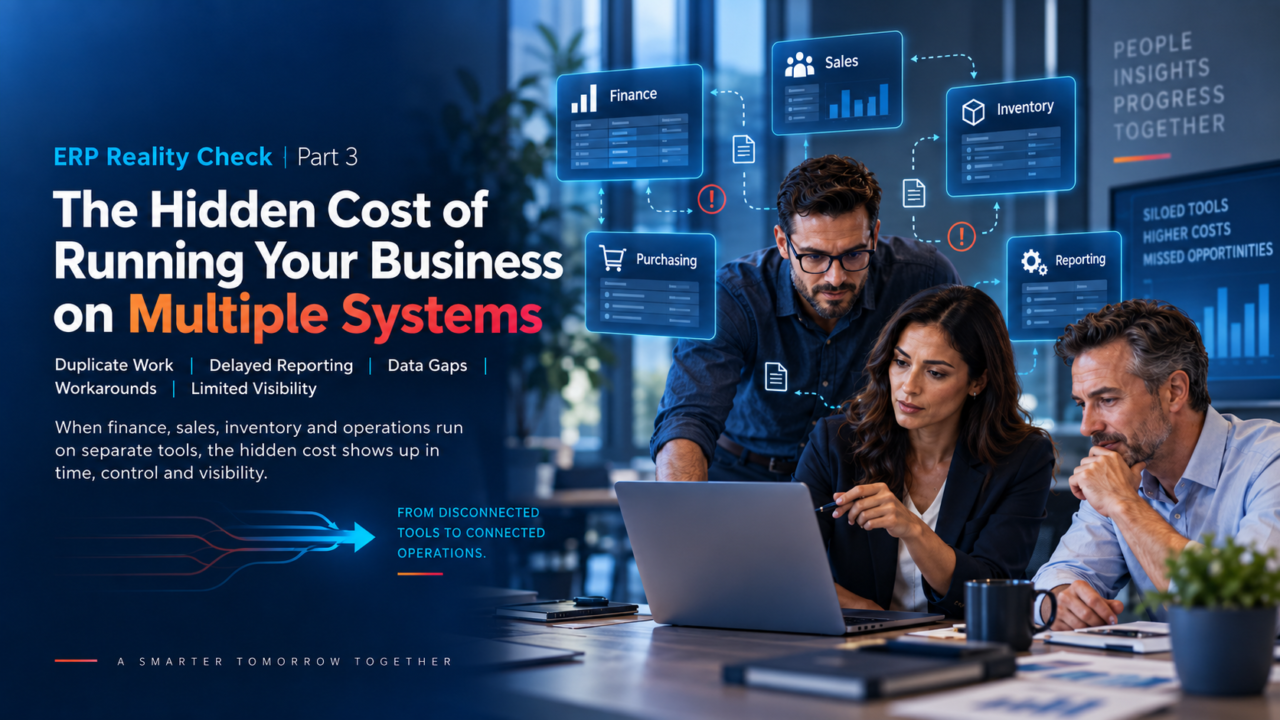
Each system may solve a specific problem, but together they can create a bigger one. Teams re-enter the same information, reports have to be reconciled manually, integrations need attention, and different departments can end up working with different versions of the truth.
The cost appears as extra administration, slower decisions, avoidable errors and time spent maintaining the process instead of improving the business.
- Duplicate data entry across finance, sales, purchasing and operations.
- Delayed reporting because information must be collected from multiple sources.
- Data inconsistencies that make it harder to trust a single business number.
- More effort spent maintaining integrations, exports, imports and workarounds.
- Limited end-to-end visibility when each department sees only its own system.
The Better Question: Can One System Replace the Complexity?
For a growing SME, the objective should not be to keep adding applications. It should be to simplify how information moves through the business.
SAP Business One ERP for small and mid-sized businesses brings core functions such as finance, sales, purchasing, inventory, production and reporting into one connected platform. That can reduce duplication, improve visibility and give teams a common operational foundation as the business grows.
Moving to ERP is not simply a software replacement exercise. A structured SAP Business One implementation should start with your processes, data and reporting needs, then remove unnecessary hand-offs and duplicate systems. Where management visibility is a priority, integrated SAP Business One analytics and reporting can help turn operational data into dashboards and reports without another layer of manual consolidation.
ERP REALITY CHECK: The highest cost of multiple systems is often not what you pay for them. It is the time, control, and visibility lost between them.